- Career
- Awesome Manager
- Organization
- Starting
- Market
- Leading Edge
Needs
- Experimental
- Relational
- Highly directive
Fails by
Bringing in rigid process too early. In a company still finding its market, that kills the business.
The Fabulous Leadership Framework
For decades, years of experience were the safest bet in leadership. Experience solves complicated problems: the kind with a right answer, if you know enough. That's exactly the kind AI now solves faster and cheaper than any résumé.
The problems that decide what happens next are complex: no right answer waiting, cause and effect clear only in hindsight. Experience doesn't transfer to them. Adaptability does: reading what you're actually facing, and unlearning a habit of success fast enough to meet it. Fabulous Leadership crafts leaders with that capacity, who don't just succeed but pay it forward and use it to reinvent the world.
Built different, on purpose
The premise
A fixed set of traits that works in any role, company, or market
The right mindset is relative, set by six coordinates that keep moving
The problem
Complicated problems with a right answer, if you have the expertise
Complex problems with no right answer waiting to be found
The method
Add skills, models, and content
Unlearn the habit of success that's stopped working, then build what replaces it
The hard part
A "transition period" on a change curve
The Circle of Suck®, named honestly, because that's what it feels like
The AI era
Expertise is the leader's edge
Expertise is being commoditized. Judgment, trust, and character aren't.
Are you Fabulous?
Fabulous DNA has two layers. Four Non-Negotiables are the baseline: without them, no amount of coaching produces adaptability, because the belief system underneath is closed to it. Four active behaviors, the 4Ds, convert that baseline into performance under real pressure.
The Four Non-Negotiables
Self-aware about personal values, consistently harmonized with the organization's.
Authentic translation, not eloquence: reading an audience's register and speaking into it.
The stamina to sustain high-effort change over years, not weeks.
Full ownership of outcomes, no victim posture.
The 4Ds
Bold, calculated moves made with imperfect information.
Genuine comfort with fluidity, not just tolerance of it.
Clinical focus on what matters, equally clear about what to ignore.
Treating failure as data, not identity threat.
Why one size never fits all
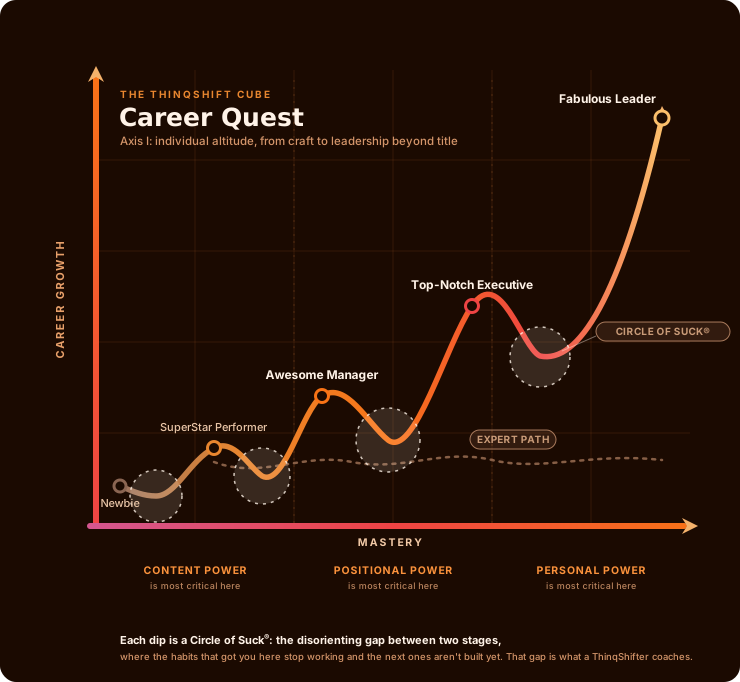
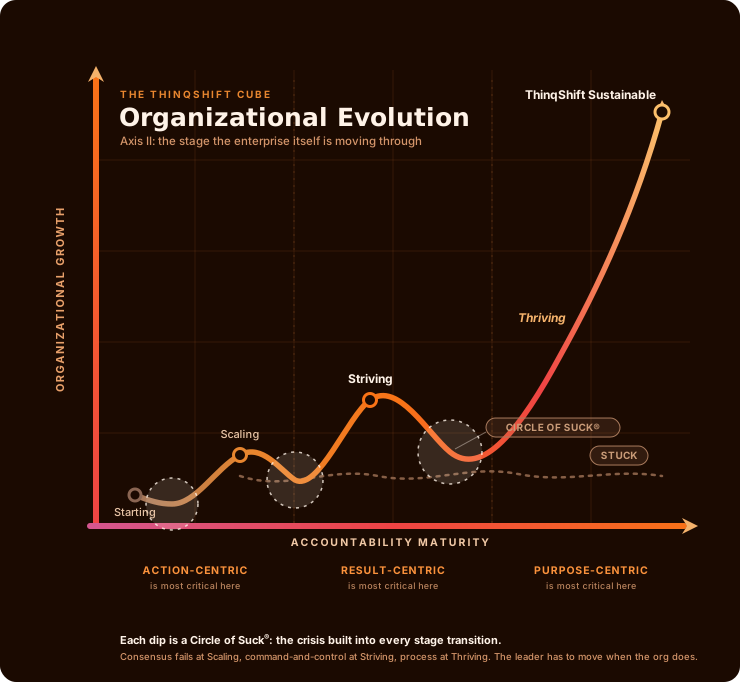
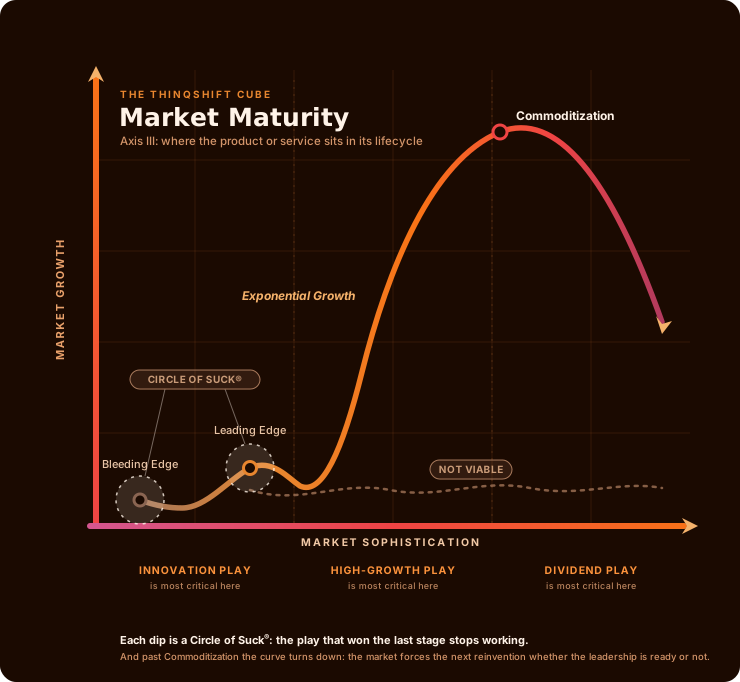
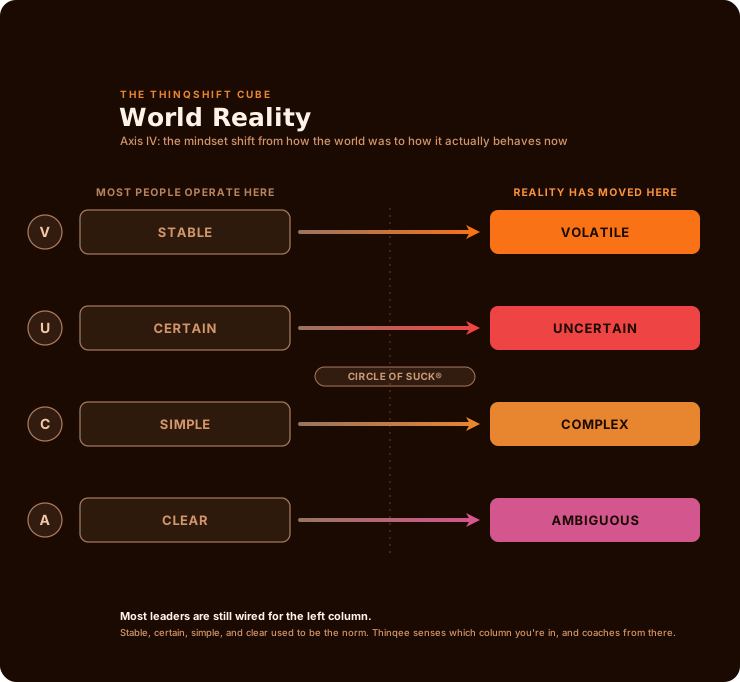
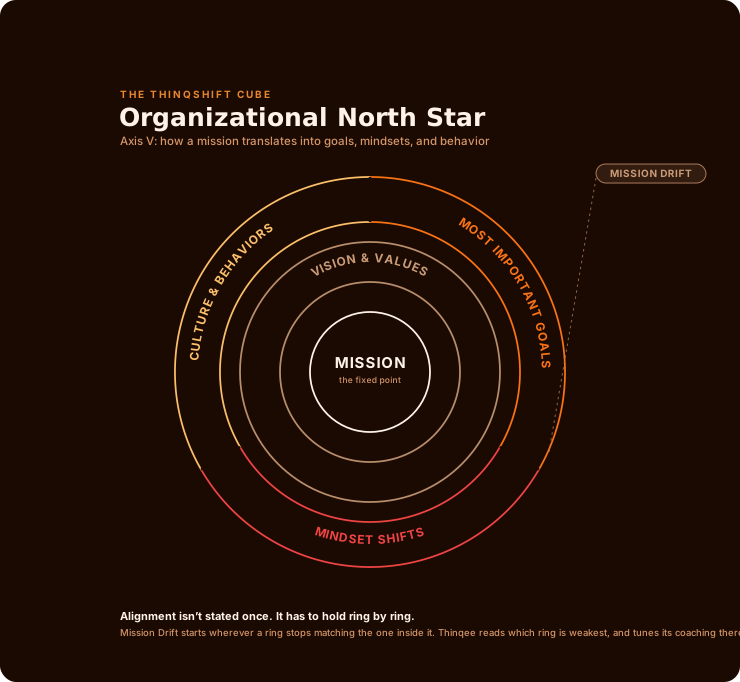
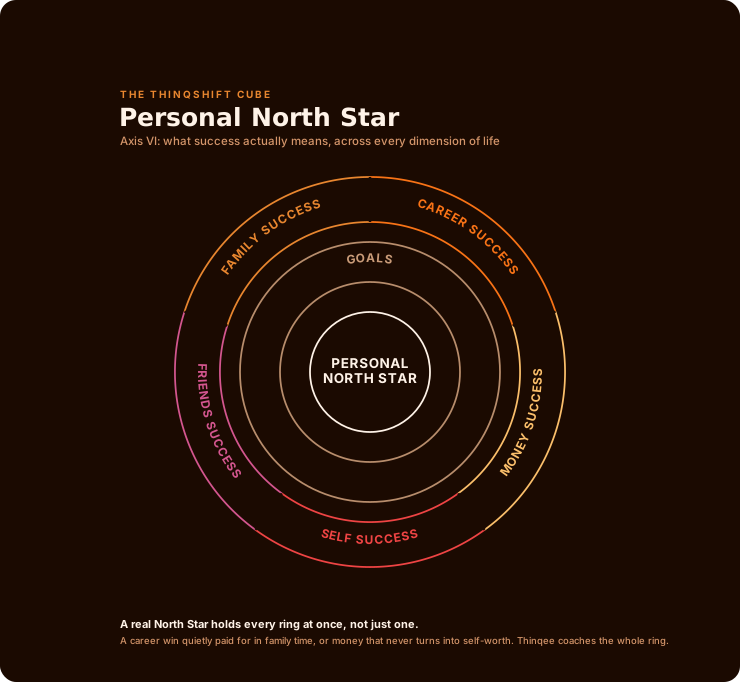
Most leadership frameworks assume a fixed set of traits works everywhere. The Cube starts from the opposite premise: the right mindset for a leader is relative. Career altitude, organizational stage, and market maturity triangulate first; the world's VUCA reality (how volatile, uncertain, complex, and ambiguous it has become) and the Organizational and Personal North Stars close the loop. Six coordinates, one mindset: the one the moment genuinely requires. Click a face of the Cube to explore it full-size, or browse all six below.
Read your coordinates. Adapt to them. Then notice when they move, because they will, whether you do or not.
Triangulation in practice
Two Awesome Managers, identical on paper. Change two coordinates and the leadership each one needs flips completely.
Needs
Fails by
Bringing in rigid process too early. In a company still finding its market, that kills the business.
Needs
Fails by
Improvising. The instinct that made the first manager brilliant gets this one removed as a compliance risk.
One size doesn't fit all. That isn't a slogan; it's the mechanism.
The transition cost of not adapting
When an organization moves to its next stage and a leader's mindset doesn't move with it, their effectiveness drops even though nothing about them changed. The founder who thrived on startup chaos finds the same instincts working against them once the company scales. Every stage has its own crisis waiting at the edge:
Most leadership failure doesn't happen inside a stage. It happens at the boundary.
What happens at every boundary
Every time your coordinates shift (a promotion, a market turn, an organization changing stage), the habits that made you successful stop working. An inflection is what happened. The Circle of Suck is what it feels like to live through it. We kept the blunt name on purpose: "change curve" describes the same territory and drains out everything true about it.
A Fabulous Definition
Circle of Suck® noun
A predictable state where the only way to succeed is by rewiring your mindset: unlearning old habits of success and experience, and creating new ones.
Why it mattersOld habits have to be actively unlearned, not just supplemented, before new ones take hold. That's the moment coaching actually earns its keep.
1. Triangulate and focus
Find where you stand on all six coordinates, and which shift matters most right now.
2. Unlearn, with a ThinqShifter
The deep, human work of letting go of a habit of success that's stopped paying off.
3. Rebuild through practice
Brain Training Practices (structured reflection and repetition) wire in the new habit.
4. Hold it with Thinqee
Real-time prompts between sessions catch the moment you slip back to the old way.
We don't hand you new facts. We help you survive letting go of what used to work.
The Personal North Star
The sixth coordinate asks what success actually means across all five dimensions of a life. Win in one by quietly borrowing from the others and the Cube has a name for it: Tunnel Vision.
The work, the altitude, and the next shift it will ask of you.
The people who live with the consequences of your calendar.
The relationships that tell you the truth, outside the org chart.
Health, energy, and the stamina real change takes.
Enough security to make bold calls, not fearful ones.
Leaders rarely stumble on career alone. So we never coach career alone.
The cognitive engine
Fabulous Leaders don't default to one thinking style. They move deliberately across two models.
Whole Brain Thinking: four voices, and the discipline of knowing which one a moment calls for
Logical, metrics, ROI. The case that holds up under scrutiny.
Creative, big-picture, futures-oriented. What hasn't been tried yet.
Structured, risk-aware, procedural. What protects what's already working.
Empathetic, trust- and culture-focused. What the room actually needs to hear.
The 5 Levels of Thinking
The right answer at one level is often the wrong answer at another. This is also a tool for alignment: two people disagreeing about "the right call" are often reasoning at two different levels without realizing it.
TacticalMINUTES / HOURS
Task execution: getting the immediate thing done, correctly and now.
OperationalDAYS / WEEKS
Running the process: keeping the machine working smoothly day to day.
StructuralMONTHS / QUARTERS
Designing the system: the architecture that shapes how work actually happens.
SystemicYEARS / DECADES
Macro trends: where the organization, market, or world is actually heading.
PhilosophicalSTANDING
Values, purpose, ethics: the anchor that doesn't move with the moment.
Fabulous Leaders learn to deliberately check a decision against more than one level before committing to it. The Cube maps who someone needs to become; the 5 Levels are a lens for any given problem, regardless of where someone sits on the Cube.
Leadership in the AI era
Being commoditized
What you know, and the complicated problems expertise alone can solve. AI is now very good at exactly this, and getting better.
What can't be automated
Authenticity, trust, character, judgment in situations that don't have a discoverable right answer. As AI takes on the complicated work, the human leader becomes the Front Human: the moral and emotional anchor for an increasingly AI-driven organization. Not competing with the machine. Needed precisely where things get complex rather than merely complicated.
Rewire, Academy, and Orchestrate are the three ways this becomes practice, not theory.